

The WSBA established the Well-Being Task Force in January 2024 with a clear mandate: to advance the well-being of Washington’s legal professionals by identifying systemic challenges and recommending actionable strategies. The Task Force Charter emphasizes alignment with national standards, including The path to lawyer well-being, and recognizes that the well-being of legal professionals is essential to both competent and ethical practice.
The WSBA Board of Governors adopted member well-being as an organizational priority in November 2023, underscoring the importance of this work. Among the WSBA’s Strategic Goals is member well-being, which means it is an area of highest focus for the Bar the Board chartered a task force to conduct wide-ranging surveying and research to help us understand how to best support members’ well-being.
This report represents the culmination of the Task Force’s efforts and is presented to the Board at the conclusion of the Task Force’s term in March 2026. It synthesizes findings and recommendations from eight specialized workgroups, each focused on a distinct area of concern, and provides a roadmap for improving wellbeing across the legal profession in Washington.
READ THE FINAL REPORT
KEY FINDINGS FROM THE REPORT
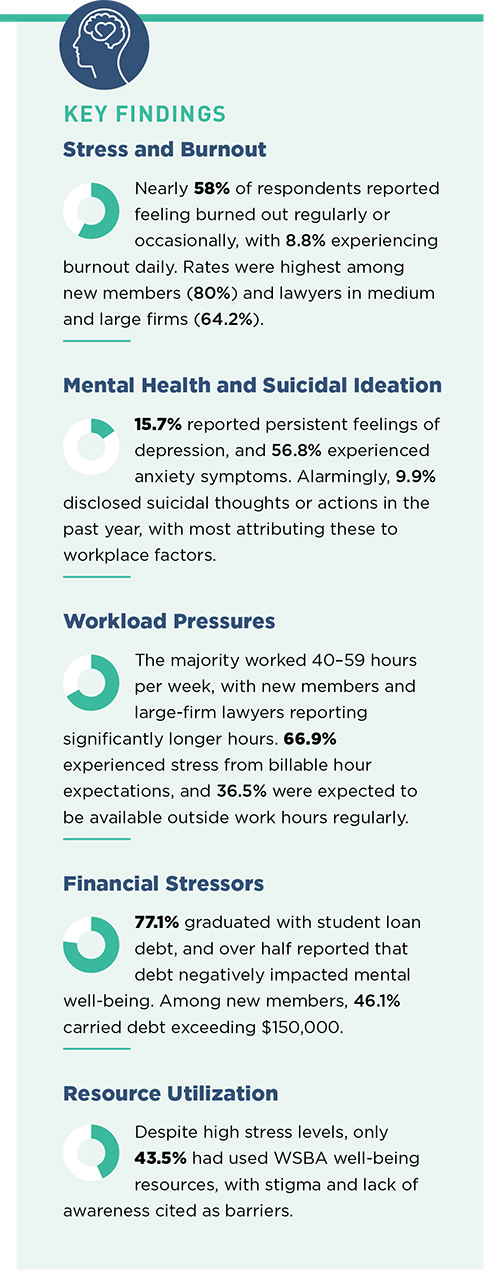
Drawing on findings from eight specialized workgroups and the WSBA Well-Being Survey, this final report highlights widespread stress, burnout, and mental health concerns across the profession. Lawyers in private practice and government roles report the highest levels of strain, while early-career lawyers face compounded challenges from heavy workloads, imposter syndrome, and significant law school debt.
The Task Force does not claim statistical causality or correlation when discussing the results of the segment analyses. Further research and analysis of each segment would be necessary to draw those statistical determinations.
The survey achieved 903 responses (approximately 9% response rate) from a proportional sample of WSBA members across Washington, yielding a 99.8% confidence level with a 5% margin of error.
This robust dataset provided critical insights into the well-being of Washington’s legal professionals and informed the Task Force’s recommendations. The survey also included segmentation analysis across practice settings, career stages, and demographics, revealing unique stressors for solo practitioners, government lawyers, and new members.
These findings underscore systemic challenges in workload, workplace culture, and access to support. Relevant findings from the survey will be referenced throughout the report in each workgroup section to provide context and support for recommendations.
Supplemental surveys conducted by other work groups explored domain-specific issues; however, these should not be conflated with the primary survey.
THE WORKGROUPS
Law Student & New Member Workgroup
The Law Student and New Member Workgroup’s approach incorporates a thorough review of existing research, new data collection via targeted outreach, and the formulation of actionable recommendations. As part of its research, the workgroup reviewed national and institutional studies.
Key Insights
- Wellness defined as balance, mental clarity, and self-care
- Barriers included stigma, lack of time, institutional norms
- Desire for more visible and culturally integrated wellness support
- Positive impact of wellness services when accessed
Recommendations
The workgroup developed a four-stage progression and additional recommendations.- Provide General Support
- Offer presentations on stress, anxiety, depression, substance use, suicidality, addiction, interpersonal effectiveness, empathy, community building, boundary setting, motivation and focus, sleep and diet hygiene
- Establish a calendar of events aligned with industry trends
- Develop mental health support packages for selfuse
- Foster Connection to Resources
- Explore and document targeted resources within and outside of WSBA
- Provide insight into legal culture to bridge communication with decision makers
- Facilitate Community Building
- Collaborate intentionally on programming
- Recruit external experts for presentations (legal professionals, substance use consultants, organizational psychologists) targeted to support new members
- Develop peer support groups, yoga classes, allyship initiatives
- Explore a formal mentorship program for new members
- Cultivate Culture Change
- Encourage myth-busting and resilience models
- Provide opportunities for interpersonal mediation and crisis prevention
- Normalize holistic care for legal professionals
- The workgroup suggests WSBA flag these recommendations to the Washington New Member Committee and New Member Education Program
- Implement Well-Being Curriculum in Law Schools
- Mandatory well-being course at the start of law school and annually thereafter
- Provide Well-Being CLEs
- Deliver more CLE credits to support practitioner well-being
Additional Recommendations
Private Practice Workgroup
The Private Practice Workgroup examined well-being challenges for lawyers in solo/small, medium, and large firms through survey data and a supplemental solo/ small firm practice survey, and review of other states’ initiatives. These findings informed recommendations aimed at addressing systemic and cultural barriers to well-being.
Common Themes & Conclusions
Several overarching themes emerged from both surveys and workgroup discussions. Stigma remains a pervasive barrier, preventing lawyers from seeking help for mental health or substance use concerns. Many respondents expressed fear that disclosure could harm their reputation or career, reinforcing the need for confidential and anonymous resources. Isolation, particularly among solo and small firm practitioners, was identified as a significant contributor to stress and burnout. Respondents emphasized that programs fostering connection, even those not explicitly well-being focused, can have a meaningful impact on well-being.
Additionally, cultural factors within the profession, such as adversarial norms, perfectionism, and billable hour pressures were repeatedly cited as drivers of stress. These systemic issues cannot be solved by individual effort alone; they require organizational and community-level interventions. The workgroup concluded that addressing these themes through education, mentorship, and employer engagement is essential to creating a sustainable culture of well-being.
Recommendations
- Make more CLEs focused on well-being available and make one such CLE per year mandatory
- Publish “Stories from the Trenches”
- Make well-being resources available without a login
- Create programs to build community and support for Small/Solo Practices
- Develop a mentorship program for new lawyers
- Implement a Well-Being Pledge with resourcing from WSBA
Through well-being-focused CLEs, law firms and WSBA can equip lawyers with tools and knowledge they need to maintain their mental health and resilience in the face of an inherently high-stress career. These CLEs could address topics such as stress management, mindfulness, burnout prevention, and work-life balance. The WSBA currently offers four complementary programs each year: a one-credit free CLE on well-being ethics, two Legal Lunchbox CLEs, and a free CLE during Well-Being in Law Week. At minimum, WSBA should maintain this level of free programming and explore expanding it further. A WSBA well-being MCLE requirement of at least one well-being CLE credit annually would help reduce stigma and signal that mental health is as important as legal skills, encouraging lawyers to seek support without fear of judgment.
Access to real-life narratives from lawyers about their struggles and successes with well-being through publication in Bar News or the WSBA website (anonymous or attributed) would help members feel less isolated and foster a culture of openness. These stories should cover diverse topics, including mental health, substance use, and resilience strategies.
Fear of stigma prevents many lawyers from accessing WSBA well-being resources that require login or direct contact. Publishing a list of vetted well-being professionals—therapists, counselors, coaches—without login requirements that could appear in Bar News or on the WSBA website would ensure confidentiality and ease of access.
Isolation was cited as a major barrier by 31% of solo/small firm respondents. The WSBA should create programs that foster connection, such as small-group coaching, local networking events, and WSBA-sponsored discounts for well-being services like gyms and counseling. These initiatives would provide both professional and personal support, reducing loneliness and stress.
entorship is a proven strategy to reduce isolation and support new lawyers. The WSBA should create a structured mentoring program pairing all newly minted lawyers with experienced lawyers for 12–18 months. Features should include CLE credit for participants, a uniform curriculum, individualized plans, and mentor training that incorporates Mental Health First Aid. Group mentoring options should also be offered to build community.
Employer policies significantly influence lawyer wellbeing. The WSBA should adopt a program modeled on Colorado’s Well-Being Pledge, which provides resources, guidance, and recognition for firms that commit to promoting flexibility, civility, and mental health support. This initiative would encourage systemic change and accountability within private practice environments.
Government & Public Interest Workgroup
The Government and Public Interest Workgroup focused on identifying well-being issues specific to lawyers in government or legal aid settings. This includes criminal prosecution and defense, civil practice representing government entities, legal aid, and other public interest contexts, including Qualified Legal Service Providers within Washington. These lawyers are referred to throughout this report as “GPI lawyers.”
Government lawyers work in environments that differ markedly from private practice. Public interest lawyers often deal with difficult subject matter, including criminal law, family defense, immigration, and other areas that place enormous strain on the lawyer. As one survey respondent stated: “We can’t discuss our client issues with mental health professionals because of client confidentiality. It all just lives in my head… what people have done to each other eats at my soul like cancer.” The GPI carried out its mission with a two-pronged approach:
- Examine the results of the WSBA Well-Being Survey and determine whether there were significant differences in survey answers between GPI lawyers and all other lawyers answering the survey (“general population”).
- Develop a supplemental well-being survey that explored issues unique to GPI lawyers.
Key Findings
Several key drivers of professional satisfaction emerged as significant supports for practitioner well-being. A substantial majority of respondents (83%) identified mission-driven work as a primary contributor to their mental health, while 77% cited the importance of job stability. Furthermore, 71% of those surveyed highlighted professional camaraderie as a critical factor in maintaining a healthy work environment. Financial incentives also play a structural role in retention and stability, with over 60% of respondents noting that the Public Service Loan Forgiveness (PSLF) program directly influenced their decision to remain in public service roles.
The following data highlights the primary negative factors and systemic stressors currently undermining attorney well-being and retention. A significant majority of respondents (76%) identified low salary as a primary barrier to professional sustainability, while 69% cited the prevalence of long work hours as a recurring challenge. Beyond these structural issues, the emotional toll of legal practice is evident: 62% of practitioners reported burnout stemming from compassion fatigue, with 33% specifically noting its negative impact on their overall well-being. Additionally, 29% identified vicarious trauma as a significant factor impeding their professional health, suggesting a critical need for enhanced psychological support and trauma-informed management within the bar.
Recommendations
The GPI identified potential areas for increasing lawyer well-being that encompass the whole person. Recommendations include:
- Improve Working Conditions and Court Rules
- Develop Well-being Support Programs Targeted to GPI Lawyers
- Create Mutual Support Programs
- Expand Mental Health Education and Resources
- Offer Physical Well-being Support Programs
- Reduce Caseloads
- Develop Best Practices Toolkit
Advocate for reforms in court rules to reduce unhealthy filing deadlines and conflicting trial schedules. Increase judicial training to enhance professionalism and civility in the courtroom, reducing stress for GPI lawyers.
Focus WSBA Member Wellness Program resources on addressing secondary trauma and compassion fatigue. Provide robust education and support tailored to the unique challenges faced by GPI lawyers, including tools for managing emotional exhaustion.
Recruit and train WSBA peer advisors to help GPI lawyers manage stress, burnout, and trauma. Maintain an accessible directory of organizations offering mutual support programs, such as Washington Lawyers Assisting Lawyers, to foster community and resilience.
Provide education to dispel stigma and clarify that seeking mental health treatment will not result in disciplinary action. Promote mental health resources broadly and accessibly. As one supplemental survey respondent noted, “There seems to still be a feeling among Bar members with mental or behavioral health disorders that taking leaves of absence, seeking alternative treatments, or admitting to needing treatment… may lead to a determination that they are unfit to practice law.” WSBA should communicate clearly—through rules, standards, and outreach—that seeking help is safe and encouraged.
Examine the feasibility of partnering with gyms or well-being providers to offer discounted memberships. Encourage physical activity as a proven method to reduce stress and burnout, contributing to increased effectiveness in legal practice. Nearly 55% of public interest lawyers indicated this resource could support their wellbeing.
Advocate for manageable caseload standards to alleviate stress and improve retention. High caseloads are driving many public interest lawyers, particularly prosecutors and public defenders, out of the field. WSBA has issued updated criminal defense caseload standards, and the Washington Supreme Court has revised its standards. While implementation remains challenging, WSBA can convene stakeholders—including public defense employers and judicial administrators—to address these issues and emphasize the link between excessive workloads and lawyer burnout, suicide, and substance use.
Create toolkits for GPI lawyers outlining client expectations, timelines, and strategies for managing trauma and stress. Partner with Qualified Legal Service Providers and agencies like Office of Public Defense to deliver training and practical resources.
Judiciary Workgroup
The Judiciary Workgroup focused on identifying well-being issues unique to judges across all levels; Municipal, District, Superior Courts, the Court of Appeals, and the Supreme Court. Two workgroup members also serve on the Judicial Assistance Services Program (JASP) which provides confidential peer support to judges facing mental health, substance use, or other challenges.
The workgroup’s mission was to develop recommendations to improve judicial wellbeing through a multi-pronged approach: creating a supplemental survey to explore issues unique to judges, analyzing WSBA Well-Being Survey data for judicial trends, reviewing extensive written comments for qualitative insights, and conducting a literature review of judicial well-being research.
Overlapping Concerns that Affect the Judiciary
Judges serve in courts with varying resources, creating disparities in administrative support and access to specialized proceedings. On-call warrant duty often requires judges to be available 24/7, disrupting sleep and family life. Governance structures based on seniority can leave newer judges feeling excluded from decision-making. Security concerns remain pressing, with judges exposed to threats and lacking adequate protections such as secure parking or courthouse access.
Recommendations
The workgroup developed a four-stage progression and additional recommendations.
- Establish Onboarding and Mentorship
- Expand Judicial College
- Address Warrant Duty
- Enhance Security and Safety
- Study Workload and Advocate for Resources
- Expand Access to Resources for Smaller Jurisdictions
- Promote Respectful Appellate Opinions
- Prioritize Judicial Well-being
Adopt a formalized mentorship program for new and experienced judges. Pair mentors and mentees based on needs and experience, even across different court levels, to provide consistent support and guidance.
Extend Judicial College to two weeks, possibly split into two one-week sessions. Include sessions on caseload management, mindfulness, and court calendar administration, along with practical training on what judges can do—not just what they should avoid.
Develop rotating schedules for after-hours warrant duty across all judges in a county, ensuring on-call duty counts as a judicial day. Encourage courts to allow judges time off the following morning to recover, promoting safety and performance.
Add Judicial College sessions on handling threats and disturbing communications. Consider statewide tracking of threats through the Administrative Office of the Courts and explore security upgrades such as cameras and secure parking.
Conduct a study tracking hours worked beyond court sessions to quantify workload demands. Use this data to advocate for additional judicial resources and staffing.
Support legislation enabling courts to contract across jurisdictions for specialized proceedings, such as competency hearings and therapeutic courts, ensuring equitable access to resources statewide.
Encourage appellate courts to adopt language that respects trial judges when overturning decisions. Communicate this cultural shift through articles and judicial trainings.
Integrate well-being sessions into judicial conferences as plenary topics. Encourage monthly gatherings for judges within each county to foster collegiality. Broaden JASP’s role to include confidential problem-solving and support for new judges.
CRITICAL ISSUES ACROSS THE PROFESSION
Suicide and Addiction Workgroup
The Suicide and Addiction Workgroup was formed to examine the prevalence of substance use disorders and suicide among lawyers in Washington State. Unlike workgroups focused on practice domains, the workgroup addressed urgent forms of suffering in the profession. As a supplement to the WSBA Well-Being Survey, the workgroup designed and implemented a confidential survey focused on suicide and addiction.
The purpose of which was to better understand the scope and nature of suicide risk, alcohol, and substance use in the profession — issues often underreported due to stigma, fear of professional consequences, and cultural norms emphasizing self-sufficiency and not asking for help.
Exploring the Interrelationships
Research indicates strong correlations among burnout, anxiety, depression, substance misuse, and suicidal thinking. Among physicians, burnout is tightly linked to depression, anxiety, suicidality, and substance abuse.9 Preventive interventions that address earlystage distress are therefore essential to reduce laterstage substance misuse and suicidal behavior. Suicidal behavior is best understood as a continuum running from ideation, intent, attempt to completion. Notably, between one quarter and one half of individuals in treatment for substance use disorders report suicidal ideation,10 and substance use disorders amplify suicidal behavior in the general population, with lifetime suicide attempt rates ranging from 16%–60% among those diagnosed.11
Suicide in the Profession
Lawyers face elevated risk of death by suicide. Nationally, the suicide rate among lawyers is eighth among working professionals.12 In Washington, Department of Health data (inclusive of legal professionals such as paralegals and legal assistants) identified 55 suicides between 2018 and 2023, meaning 30–36% of injury-related deaths among legal professionals were suicides—markedly higher than the 15–25% seen in the general population.13 Lawyers are significantly more likely to report suicidal ideation “several days” or “more than half the days” compared to the general population.14 In addition, 17.5% of lawyers met criteria for Major Depressive Disorder versus 8.3% in the general population.15 Converging evidence identifies high work overcommitment, perceived stress, and loneliness as key predictors of suicidal thinking.16 Studies also show that legal professionals are less likely to seek help—partly due to fear of discipline or reputational harm.17 The workgroup’s findings among WSBA members corroborates these patterns.
Substance Use Among Lawyers
In 2016, Krill et al. surveyed 12,825 lawyers across 15 states and found that 20.6% reported problematic drinking, versus 11.8% of the general population.18 Granular data on illicit drug use remains limited. Krill’s follow-up, Stress, Drink, Leave, surveying 2,863 California and D.C. lawyers, found women reporting greater severity of mental health symptoms and alcohol use than men; women with problem drinking were more likely to consider leaving the profession (25% vs. 17% for men).19 Reasons diverged by gender: women cited work–family conflict most often; men cited work overcommitment.
Legal Practice and Professional Stressors
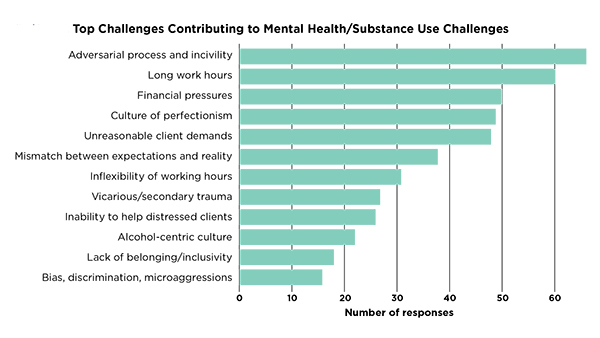
Well-Being Survey participants identified multiple contributors to poor mental health and substance risk. The top five were:
- 76.9% adversarial process and incivility
- 72.8% long work hours
- 59% financial pressures
- 55.4% culture of perfectionism
- 34.4% unreasonable client demands
Recommendations
The workgroup developed a four-stage progression and additional recommendations.- Provide General Support
- Offer presentations on stress, anxiety, depression, substance use, suicidality, addiction, interpersonal effectiveness, empathy, community building, boundary setting, motivation and focus, sleep and diet hygiene
- Establish a calendar of events aligned with industry trends
- Develop mental health support packages for selfuse
- Foster Connection to Resources
- Explore and document targeted resources within and outside of WSBA
- Provide insight into legal culture to bridge communication with decision makers
- Facilitate Community Building
- Collaborate intentionally on programming
- Recruit external experts for presentations (legal professionals, substance use consultants, organizational psychologists) targeted to support new members
- Develop peer support groups, yoga classes, allyship initiatives
- Explore a formal mentorship program for new members
- Cultivate Culture Change
- Encourage myth-busting and resilience models
- Provide opportunities for interpersonal mediation and crisis prevention
- Normalize holistic care for legal professionals
- The workgroup suggests WSBA flag these recommendations to the Washington New Member Committee and New Member Education Program
- Implement Well-Being Curriculum in Law Schools
- Mandatory well-being course at the start of law school and annually thereafter
- Provide Well-Being CLEs
- Deliver more CLE credits to support practitioner well-being
Additional Recommendations
Law Student & New Member Workgroup
The Law Student and New Member Workgroup’s approach incorporates a thorough review of existing research, new data collection via targeted outreach, and the formulation of actionable recommendations. As part of its research, the workgroup reviewed national and institutional studies.
Key Insights
- Wellness defined as balance, mental clarity, and self-care
- Barriers included stigma, lack of time, institutional norms
- Desire for more visible and culturally integrated wellness support
- Positive impact of wellness services when accessed
Recommendations
The workgroup developed a four-stage progression and additional recommendations.- Provide General Support
- Offer presentations on stress, anxiety, depression, substance use, suicidality, addiction, interpersonal effectiveness, empathy, community building, boundary setting, motivation and focus, sleep and diet hygiene
- Establish a calendar of events aligned with industry trends
- Develop mental health support packages for selfuse
- Foster Connection to Resources
- Explore and document targeted resources within and outside of WSBA
- Provide insight into legal culture to bridge communication with decision makers
- Facilitate Community Building
- Collaborate intentionally on programming
- Recruit external experts for presentations (legal professionals, substance use consultants, organizational psychologists) targeted to support new members
- Develop peer support groups, yoga classes, allyship initiatives
- Explore a formal mentorship program for new members
- Cultivate Culture Change
- Encourage myth-busting and resilience models
- Provide opportunities for interpersonal mediation and crisis prevention
- Normalize holistic care for legal professionals
- The workgroup suggests WSBA flag these recommendations to the Washington New Member Committee and New Member Education Program
- Implement Well-Being Curriculum in Law Schools
- Mandatory well-being course at the start of law school and annually thereafter
- Provide Well-Being CLEs
- Deliver more CLE credits to support practitioner well-being
Additional Recommendations
OVERALL RECOMMENDATIONS
The Well-Being Task Force committed to advancing the well-being of legal professionals, not only at the individual level, but also through systemic reforms within legal institutions that adversely affect professional health. To support this mission, the Task Force established eight workgroups covering a wide range of legal professionals and topics.
Four workgroups focused on distinct areas of legal practice: the Law Students and New Members Workgroup, Private Practice Workgroup, Government and Public Interest Workgroup, and Judiciary Workgroup. Two workgroups addressed critical issues impacting the profession: the Suicide and Addiction Workgroup and the Diversity, Equity, and Inclusion Workgroup.
Two additional workgroups concentrated on bar association and regulatory matters: the Member Wellness Program Workgroup and the Rules and Regulatory Workgroup. Collectively, these workgroups provide a comprehensive framework for promoting well-being and fostering meaningful change across the legal community. Each workgroup conducted research, reviewed relevant literature, and engaged stakeholders to identify challenges and propose solutions. Some work groups supplemented their analysis with targeted surveys to capture perspectives unique to their focus area. This report consolidates those findings and recommendations into a unified document, structured to present findings first, followed by actionable recommendations for each area.
Five Recommendation Themes Emerged Across Workgroups
- Normalize help-seeking through clear, repeated communications and leadership modeling that reduce stigma and make it safe to use support without fear of disciplinary consequences.
- Expand education and training, including no- or low-cost continuing legal education programs (CLEs) and practical skills such as Mental Health First Aid, trauma-informed practice, boundary setting, and productivity as well-being.
- Improve access to resources and protect confidentiality by offering anonymous, easy-to-find referral directories; extending after-hours/telehealth options; and forging partnerships (e.g., gym/well-being discounts) that meet members where they are.
- Build connection and mentoring at scale — from structured mentorship for new lawyers and judges to peer support networks and small-group communities that reduce isolation, especially in solo/small practice and rural benches.
- Pursue structural and policy reforms like reasonable caseload/workload standards, court and regulatory updates (e.g., well-being aligned rules/ comments), and an employer Well-Being Pledge—to align incentives with sustainable practice. Above all, leadership must drive a cultural shift that treats well-being as integral to professional competence and ethical practice. By embracing these recommendations, Washington can lead the nation in creating a legal profession where well-being is not aspirational but foundational.